The Silent Guardians of Fluid Integrity: A Deep Dive into Rubber Gaskets
In the world of industrial engineering, it is often the smallest components that carry the heaviest responsibilities. Enter the Rubber Gasket.
Whether it is preventing a catastrophic leak in a high-pressure chemical line or ensuring the watertight seal of a simple household faucet, rubber gaskets are the mechanical seals that keep our world running smoothly. At
What is a Rubber Gasket?
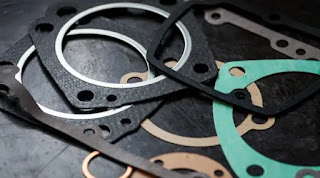
A rubber gasket is a flexible seal used to fill the space between two or more mating surfaces. Its primary job is to prevent leakage (of liquids or gases) while the joined objects are under compression. Because metal-to-metal surfaces are rarely perfectly flat, the "squish" or compressibility of rubber allows it to flow into microscopic irregularities, creating a hermetic seal.
Choosing the Right Polymer: The Science of Sealing
Not all "rubber" is created equal. Choosing the wrong material can lead to "compression set" (losing its bounce) or chemical degradation. Here are the most common materials used in industrial gaskets:
1. Nitrile (Buna-N / NBR)
Best for: Oil and fuel resistance.
Common Use: Hydraulic systems and automotive seals.
Limitation: Poor resistance to weathering and ozone.
2. EPDM (Ethylene Propylene Diene Monomer)
Best for: Weather, water, and steam resistance.
Common Use: Outdoor pipelines and HVAC systems.
Limitation: It will degrade rapidly if exposed to oils or petroleum products.
3. Viton™ (FKM)
Best for: High temperatures and aggressive chemicals.
Common Use: Aerospace and chemical processing.
Limitation: Higher cost compared to standard elastomers.
4. Neoprene (Chloroprene)
Best for: Moderate oil resistance and excellent physical toughness.
Common Use: Marine environments and bridge bearings.
Key Factors in Gasket Selection
When selecting a gasket for your project, engineers use the STAMPS method to ensure the seal won't fail:
S – Size: The ID (Inner Diameter), OD (Outer Diameter), and thickness.
T – Temperature: Does the rubber become brittle in the cold or melt in the heat?
A – Application: Is it a flange, a valve, or a pump?
M – Media: What fluid is passing through? (Acid, oil, water, or gas?)
P – Pressure: Can the material withstand the internal force of the system?
S – Speed: For dynamic gaskets, how fast is the movement?
Why Quality Manufacturing Matters
A poorly manufactured rubber gasket can suffer from flash (excess material) or voids (air bubbles), both of which create leak paths. At Asian Sealing Products, we utilize precision molding and die-cutting to ensure every gasket meets rigorous tolerance standards.
The Role of "Durometer"
The hardness of a rubber gasket is measured in "Durometer" (Shore A).
40-50 Shore A: Soft (like a pencil eraser), great for low-pressure plastic flanges.
70-80 Shore A: Firm (like a car tire), ideal for high-pressure industrial metal flanges.
Maintenance: When to Replace Your Gaskets?
Rubber is an organic polymer, meaning it ages. Even if a system isn't leaking yet, you should look for these signs of "Gasket Fatigue":
Hardening: The rubber feels brittle or cracks when bent.
Extrusion: The gasket material is being "pushed out" from between the flanges.
Discoloration: A sign of chemical attack or UV degradation.
Conclusion
From the simplest plumbing to the most complex refinery, the rubber gasket remains an indispensable tool. Understanding the chemistry and physics behind these seals is the first step toward a leak-free operation.
Need help selecting the perfect seal for your application?
Check out our high-performance sealing solutions at
Comments
Post a Comment